No Road to Ko Kret: The Mon Island in the Chao Phraya
There is no road to Ko Kret, and there has never been a bridge. To get there you stand on a concrete pier in the suburb of Pak Kret, on the northern edge of Bangkok, and wait for one of the small wooden ferries that crosses the hundred metres of brown water for a fare of four baht. The crossing takes two minutes. On the other side is an island of about four square kilometres, with no cars, around six thousand residents, a working Buddhist monastery where the monks chant in a language that isn't Thai, a pottery industry given Geographical Indication status by the Thai government in 2010, and a craft brewery whose founder ran it illegally for seven years and got fined eight times before being granted Thailand's first legal small-batch brewing licence in 2018. Bangkok is over your shoulder. From the ferry you can see the apartment towers of Nonthaburi rising above the palms. This is fifteen kilometres from the centre of one of the largest cities in Southeast Asia. The island was made on purpose, and recently. In 1722, according to the Ayutthaya chronicles, under King Thaisa, ten thousand men spent a month digging a canal across a tight meander of the Chao Phraya, so boats carrying rice and tribute to the capital wouldn't have to follow the long loop of the river. Over the next century the river ate through the cut, widened it, and turned the bypassed loop of land into an island. The town that grew up at the southern end of the canal was named Pak Kret, the mouth of the shortcut. The labourers who made the place did not stay on it. There was nothing to stay for. The people who did come, half a century later, came as the survivors of a mutiny. The fullest account in English is Edward Van Roy's, drawing on Thai chronicles and the work of Prince Damrong: in 1774 the Burmese king Hsinbyushin, preparing to finish off the Siamese, drafted a battalion of Mon prisoners and sent them across the Three Pagodas Pass as the vanguard. The Mon, whose homeland in lower Burma had been under Burmese occupation for a generation, and whose monks and civilians had been massacred in the thousands by the same dynasty fifteen years earlier in the sack of their capital at Pegu, did not perform as expected. They massacred their Burmese commanders, turned around, fought back into Burma as far as the city of Ava, and were eventually overwhelmed and put down. Some ten thousand survivors fled across the mountains into Siam. King Taksin took them in. Their commander, a Mon noble whose name the Thais recorded as Phraya Cheng, was given the rank of Chao Phraya and a place at court. His battalion and their families were settled along the Chao Phraya from Pak Kret upstream, in defensible river positions, and some of them were given the still-empty island the canal had created. They built temples. They fired pottery from the iron-rich clay of the riverbank. They stayed. I arrive at eight in the morning, on a Saturday. This is the day the lanes are meant to fill. By eleven the covered walkways will have woken up: stalls open, carts wheeled out, Bangkok families wandering through with sweets and iced drinks on their way to one of the riverside restaurants for lunch. At eight, none of that has started. A few locals step off the ferry with me, carrying shopping bags or folded carts, and walk up the ramp ahead of me into the lanes without looking back. There is no welcome sign in English. I have the feeling of having walked into somewhere before it has opened, of being somewhere I am not quite supposed to be yet. Past the pier the path runs inland between low buildings. Most of them are shut. The first lanes are covered, with corrugated metal overhead and fluorescent tubes hanging in series, a few of them already on against the dimness. A small black-and-white sign hung from a chain reads *บ้านโอ่งอ่าง ซอย ๔* — Baan Ong'ang Soi 4, Earthenware Pot Houses Lane 4. The neighbourhood is named for what the people who built it did with their hands. Other signs, taped to poles, advertise *ข้าวต้มมัด*, sticky rice in banana leaf; *ก๋วยเตี๋ยว*, noodles; *กาแฟโบราณ*, old-style coffee. The stalls behind the signs are closed. A green plastic stool sits in front of one of them with an old man on it, watching nothing in particular. He doesn't look up. Somewhere behind the lane, the sound of a wok being moved on a gas burner and someone calling out a question in a language I can't follow. The cooking is not for me. It is for the people inside the houses. I am walking through somebody's neighbourhood at eight in the morning, and the neighbourhood happens to have shops in it, but the shops are not the point of the neighbourhood at this hour.
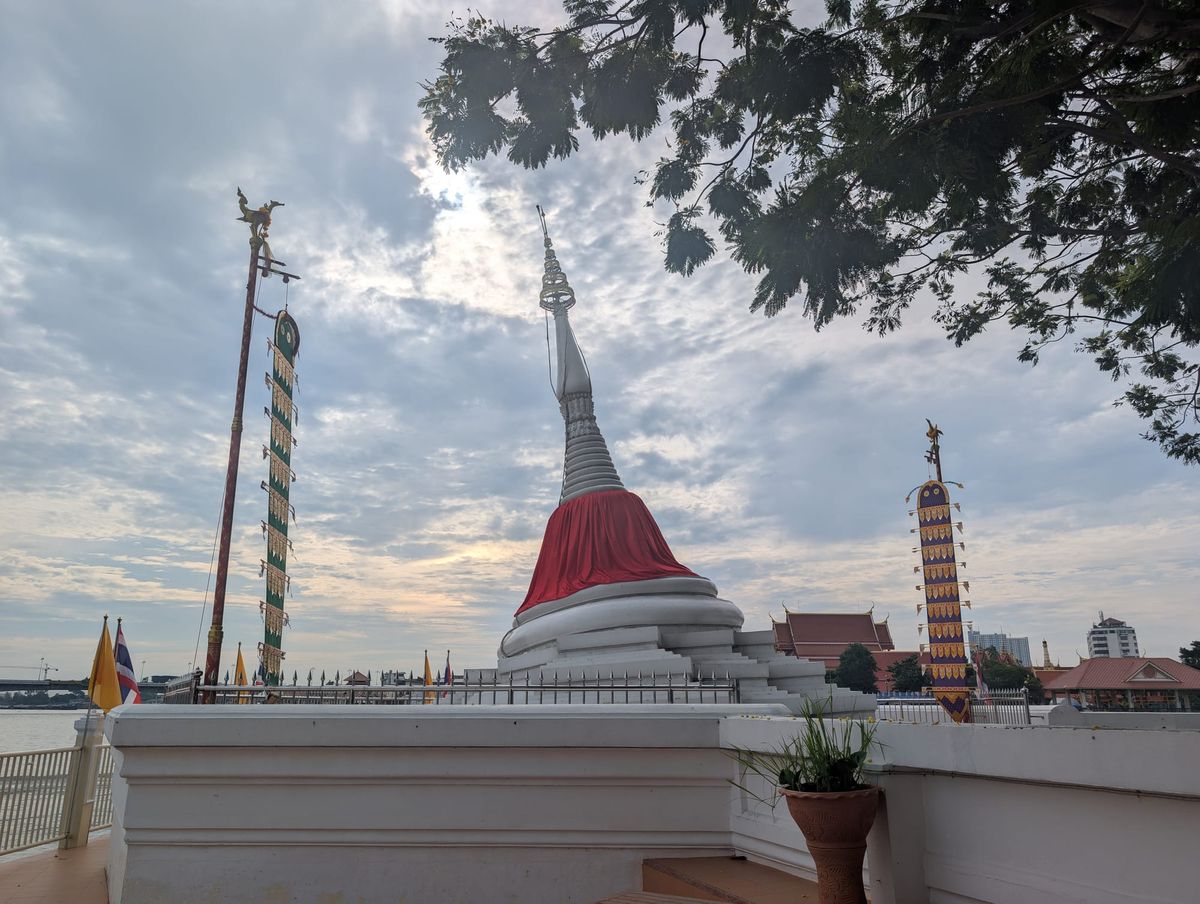
Two things about this neighbourhood matter for the rest of the piece, both of which I did not know on the morning I am describing. I learned them later, reading about the island after I had been on it. The first is that the Mon are not a hill tribe, and writing about them as one is a mistake that English-language tourism material on Ko Kret makes routinely. The Mon are a lowland civilisation. Their kingdoms — Dvaravati in central Thailand from the sixth century, Hariphunchai in the north, Thaton and Hanthawaddy in lower Burma — predate the arrival of Tai-speakers in the region by something like seven hundred years. They were the first people in mainland Southeast Asia to take up Theravada Buddhism, importing it from Sri Lanka and developing the Pali scholarship and monastic discipline they would later transmit to the Burmans, the Khmer, and eventually the Tai. The script the Thais use is descended from the Mon script. The Buddhist canon the Thais learned was learned from Mon monks. The Thai-ness of Thai Buddhism is, at its origin, Mon. The second is that the Mon are not a peripheral culture in Thailand. They are inside the Chakri dynasty. Rama I's mother was Mon. Rama IV stated openly in his royal correspondence that the dynasty was not "purely Thai" but of mixed Mon and Chinese descent. Rama V's grandmother was Mon. The temple at the southern tip of Ko Kret was named for her when he raised it to second-rank royal status in 1874. Van Roy's tally of Mon women in the inner palaces of the first five Chakri reigns gives seven in the first reign, seven in the second, four in the third, six in the fourth, and twenty-six in Rama V's — more than fifty royal consorts in total. The Thammayut order that has held most of the country's senior monastic titles since its founding was established by Rama IV after he sought out Mon monks whose practice he considered closer to the original Vinaya than what his Thai teachers had taught him, and was reordained by them. So the Mon community on Ko Kret was not a marginal group hiding from a dominant culture. It was one of the foundational communities of that culture, settled by a king who needed soldiers, on a piece of land its commanding officer kept as a country estate, twenty kilometres up the river from a palace whose dynasty was partly descended from his people. Past the lanes, at the southern tip of the island, there is a working temple with white jasmine bushes in bloom along its outer wall, the same jasmine the cooks use for *khao chae*. The chant from the open hall, where the *chedi* leans out over the river the way Mon-style stupas do, is in Mon. The grandmother of the king on the banknote was Mon. By the time I sit down to eat, the lanes have started to fill. A woman in a yellow apron is arranging trays of small steamed cakes, banana, pumpkin and purple potato, on a table inside an OTOP-certified stall whose walls are painted bright yellow and whose proprietor has propped up a sign saying One Hundred Per Cent Real Palm Sugar Juice. Down the lane another woman is putting out small bowls of crushed ice in coloured syrup. A man wheels a green cart of iced coffee past me toward the river. The restaurant I have come for is on the western side of the island, on a wooden deck overlooking the Chao Phraya. Its name is Khao Chae Lung Daeng, Uncle Red's Khao Chae. My table is number nine. The tablecloth is brown and tan in a checkerboard, the spoon is gold-coloured and slightly heavier than it needs to be, and through the wooden slats of the railing I can see the river running brown and slow about three metres below. The menu is in Thai. There are two women working the restaurant, neither of whom speaks English. One of them brings me a slip of paper and a pencil and waits while I work it out. Item one is the *khao chae* set with five accompaniments and a stuffed banana pepper, a hundred and twenty baht. Item two is the *khao chae* set with five accompaniments and no banana pepper, a hundred. I write a one next to item two and pass the slip back. The food comes out in pieces, first a bowl, then a saucer, then a small footed dish, arranged across the table. The bowl is the size of two cupped hands. The rice inside it is sitting under cold water, and the rice is blue. Deep slate, almost the colour of dusk. The colour comes from butterfly pea flower, *anchan*, cooked into the rice itself. The water has a softer perfume on top of that, jasmine and rose, traditionally jasmine and the Mon rose, *gulaap mawn*, the same pairing used in *khao chae* recipes for the last two centuries. Two ice cubes are drifting on the surface, half melted, and the water is cold enough that when I take the first spoonful the back of my teeth ache. Underneath the flowers, in the rice, there is a faint smokiness. This is the signature of the dish. The cook lights a small scented candle made of beeswax and aromatic resins, lets it burn briefly inside a sealed pot of cooked rice, snuffs the flame, and leaves the smoke to soak into the grains overnight. The technique is older than the canal the boat crossed this morning. To the left of the bowl is the *la tiang*, a single roll of egg-thread net wrapped around a filling of pork and shallot and pickled radish chopped fine. To the right is a small blue-and-white footed dish containing a tangle of shredded sweet pork, dried and fried until it is almost candy. There is no menu instruction about how to eat any of it. Neither of the women has come back. I work it out by trial. The pork goes on a spoonful of rice. The *la tiang* gets eaten alone, in two bites. The water gets sipped between mouthfuls. The dish is plain and not plain at the same time. The flavours are the flavours of a soaked grain, a salty preserved meat, an egg net, jasmine, rose, and the smoke note the candle has left in the rice. The temperature of the water is the centre of it. On a day in central Thailand in April, with the heat over thirty-five and the air not moving, the cold water of *khao chae* does what nothing else does. The dish is a thermal event before it is a flavour event. People eat it because it stops them being hot. But it would be a mistake to leave the dish at this. Because it is also several other things at once, and the island I am eating it on may be the only place where all three layers — ritual, royal, and village — are still visible in one bowl. I worked the rest of this out later, sitting in Bangkok with a stack of food histories and a tab open on McDang. The version a Bangkok food writer would tell you about — the canonical one, the labour-intensive one, the one they would call the real *khao chae* — was assembled in the inner palace of King Mongkut, Rama IV, in the 1860s, by a Mon-descended consort named Chao Chom Manda Sonklin. Sonklin's father was head of one of the Mon noble lineages descended from the 1774 settlers. She went with Mongkut in 1860 to the new hill palace at Phra Nakhon Khiri in Phetchaburi, on the coast a hundred and fifty kilometres south of Bangkok. She made *khao chae* for the king there. Phra Nakhon Khiri sits on top of a small mountain, and the morning fog comes off the surrounding rice plain and pools in the corridors, and even in April it is cool there in a way that Bangkok is not, and the dish, which depends on cold water held cold through a hot day, works at Phra Nakhon Khiri in a way that, before refrigeration, it could not in the city. The king ate it. The recipe spread out from the hill palace into Bangkok aristocratic kitchens, where the women who cooked it were, like Sonklin, mostly of Mon descent. The version of the dish that became known as the royal version was developed in the kitchens those women ran. The royal version is also where most of the labour-intensive accompaniments come in: the lacy egg-net wraps, the stuffed shallots, the small Ayutthaya catfish cakes, the pickled banana peppers, the dried fish floss, the carved garnish vegetables. *La tiang* is one of the original royal accompaniments. So is the sweet pork shred I am eating with the blue rice. The candle-smoke perfuming and the flower water are not royal additions. They are the technique the dish has always used. What the royal kitchens added was the apparatus around them. This is the version that gets the magazine spreads. McDang, who is descended from the Chakri dynasty and writes about royal Thai cuisine for a living, has said publicly that the difference between royal Thai cuisine and regular Thai cuisine is fiction. The seventeenth-century French ambassador Simon de la Loubère, watching King Narai's court eat at Ayutthaya in the 1680s, wrote that the food at the Siamese court was "generally similar to villager food," only with better ingredients and more careful presentation. The royal version of *khao chae* is what happens when villager food is given an inner palace and a hundred years to elaborate the trim. The villager version is what happens when the dish keeps being cooked without that trim. The technique stays. The accompaniments thin out. That is the version on Ko Kret. Or one of them. The blue rice in front of me is the version Lung Daeng cooks. There is no single Ko Kret *khao chae*. There is the dish, kept cold in earthenware pots and now in fridges, with whatever accompaniments the cook keeps in the kitchen, made and sold for as long as the community has been on the island. Underneath both, underneath Sonklin's palace version and Lung Daeng's blue-rice version, is the third layer. The Mon name for it is *Peng Daak*, and in Burmese it is called Thingyan rice, and in both languages it is the dish people made for the New Year, the festival the Thais call Songkran, when the heat was at its worst and you needed something to give to the monks on the morning of the new year that would not spoil. The cooks perfumed plain rice with the smoke of a candle, soaked it in cool water in sealed earthenware so the cool would last through the morning, and gave it to the monks in bowls. The cool water was the gift. The candle was the perfume. The smokiness in the bowl in front of me, three hundred years later, is the same technique. In the lower Mon-speaking world, before refrigeration, before ice, before the hill palace at Phetchaburi, before any of the Chakri kings, this is what you ate at the new year. This is also the version that came to Ko Kret with the 1774 mutineers. The dish moved up the social hierarchy by being cooked by Mon women in a palace whose dynasty had Mon ancestors. It also kept being cooked, without elaboration, by the same Mon women's relatives who stayed on Ko Kret making pottery and growing durians. By the 1860s, when Sonklin was making *khao chae* for Rama IV at Phra Nakhon Khiri, the same dish was being made on the island by women who shared her grandparents. The class history is contingent on a single technology. The reason the dish became royal in the nineteenth century is that keeping water cold through the hot season was, before ice and refrigeration, expensive. It required underground streams or sealed earthenware kept in the coolest part of a house, and the labour of refreshing the water through the day. Only the inner palace could afford to keep a dish cold long enough to be a meal. Ice arrived in Thailand in the late nineteenth century by ship from Singapore. The dish democratised. By the time refrigeration reached household kitchens in the early twentieth century, *khao chae* was no longer a class marker, just a hot-weather dish. The only two places in Thailand where I have found it sold widely and year-round are Phetchaburi, where it has been a local speciality since Sonklin made it for Mongkut in the 1860s, and Ko Kret, where the Mon community has been making it since before either of those things happened. The dish on the table in front of me is a hundred baht because there is a refrigerator in Lung Daeng's kitchen. Outside the bowl, on the same stretch of the river, the rest of the Mon dessert tradition is being sold from the stalls in the lanes I walked through this morning. The island's nickname is *Khlong Khanom Wan*, the Dessert Canal, a reference to the sugar palms that grew thickly along the riverbank in the nineteenth century and to the Mon community's reputation for sweets. *Khanom mo kaeng*, coconut custard with fried shallots scattered on top. *Thong yip*, *thong yod*, *foi thong*, the egg-yolk sweets developed in the late Ayutthaya court by a Portuguese-Japanese-Bengali woman named Marie Guimar, who became Thao Thong Kip Ma and was put in charge of the inner palace kitchens, and which the Mon community here makes today in the same forms her recipe specified. The sweet stalls run by women in yellow aprons selling thirty-baht steamed banana cakes are the visible end of a tradition that runs through the late Ayutthaya royal court, the early Bangkok aristocratic kitchens, and a Portuguese woman who married a Greek mercenary at the court of King Narai. There is one more dish. *Thot man no kala* is a fishcake, deep-fried, made with the soft inner pith of the stem of a river ginger called *Alpinia nigra* (*nor kala* in Thai), widely distributed across the wet floodplains of the Bay of Bengal and lower Southeast Asia. The plant is not unique to Ko Kret, despite what the tourist literature says. The dish is a Mon recipe that uses a plant the Mon happened to be living next to, in a way the rest of the country never adopted. You can find it at most of the riverside restaurants on the island. I have not seen it served anywhere else in Thailand. The bowl in front of me is empty. One of the women has come past with a slip of paper and put it on the table. A hundred baht. Plus ten for the additional bowl of rice. Plus thirty-five for a glass of butterfly-pea-and-lime soda. A hundred and forty-five. The river is still moving below the deck. The lanes that were empty at eight this morning are full by the time I leave Lung Daeng's. The OTOP woman in the yellow apron is selling the steamed cakes she was setting out when I arrived. The price card on her counter has a QR code printed on it for payment. This is the second mode of the same lanes. The morning version is the one the community lives in. This is the one they sell, and it has been a community decision for nearly thirty years. In the summer of 1995 the rainy season produced a Chao Phraya flood severe enough to break both of the island's inherited industries in the same six weeks. Pottery kilns cracked. The clay-pit beds along the riverbank were silted over. The durian orchards drowned, and durian roots cannot tolerate sustained inundation. The community had been on Ko Kret continuously for two hundred and twenty years and had survived earlier floods, plagues, two Burmese invasions, a Japanese occupation, and the construction of an air-conditioned suburb of Bangkok directly across the river. What it had not had, until 1995, was a year in which both of its inherited livelihoods failed at once. The answer, worked out by the Pak Kret district chief and the abbot of Wat Paramai Yikawat together, was a public offering of the island's cultural distinctiveness. A weekend market launched in 1997. Bangkok newspapers were courted. The Department of Intellectual Property granted the pottery G